0x0 Live AcpWdfWorkItem Leak
- Nick Kuo
- BSOD Analysis
- 14 Nov, 2024
Customer observed higher memory usage after using Edge to play music overnight.
Captured live dump after playing music for a while.
0: kd> !poolused 2
....................
 Sorting by NonPaged Pool Consumed

               NonPaged                  Paged
 Tag     Allocs         Used     Allocs         Used

 amda   5768754   1938325232         32         9360	UNKNOWN pooltag 'amda', please update pooltag.txt
 IoWI   5769999    646239888          0            0	Io work items , Binary: nt!io
 EtwB      1428    254173440          6       196608	Etw Buffer , Binary: nt!etw
 HalD       118    230549312          0            0	Hardware Abstraction Layer: DMA , Binary: hal.dll
 DAL3      1854    132887776          0            0	UNKNOWN pooltag 'DAL3', please update pooltag.txt
 NxRx    131587     80019584          0            0	UNKNOWN pooltag 'NxRx', please update pooltag.txt
 MKCx       190     25463552          3          288	UNKNOWN pooltag 'MKCx', please update pooltag.txt
 DAL2       877     25073840       1560      6288352	UNKNOWN pooltag 'DAL2', please update pooltag.txt
Pool Tag
Look at amda first. Searched through our codebase, didn’t find anything pointing to this tag.
I’m lazy, so I’m just going to grab a live machine and find out who uses this tag.
bp nt!ExAllocatePool2 ".if(@r8 == 0x61646d61) {} .else {gc}"8: kd> k
# Child-SP RetAddr Call Site
00 ffffd68d`7952edb8 fffff804`0591d831 nt!ExAllocatePool2 [minkernel\ntos\ex\pool.c @ 4255]
01 (Inline Function) --------`-------- Wdf01000!MxMemory::MxAllocatePool2+0x10 [minkernel\wdf\framework\shared\inc\primitives\km\MxMemoryKm.h @ 86]
02 ffffd68d`7952edc0 fffff804`0591e433 Wdf01000!FxPoolAllocator+0x81 [minkernel\wdf\framework\shared\object\wdfpool.cpp @ 379]
03 (Inline Function) --------`-------- Wdf01000!FxPoolAllocateWithTag2+0x4e [minkernel\wdf\framework\shared\inc\private\common\FxGlobals.h @ 746]
04 (Inline Function) --------`-------- Wdf01000!FxObjectHandleAllocCommon+0x143 [minkernel\wdf\framework\shared\object\handleapi.cpp @ 237]
05 ffffd68d`7952ee30 fffff804`05932273 Wdf01000!FxObjectHandleAlloc2+0x157 [minkernel\wdf\framework\shared\object\handleapi.cpp @ 296]
06 (Inline Function) --------`-------- Wdf01000!FxObject::operator new+0x2a [minkernel\wdf\framework\shared\inc\private\common\fxobject.hpp @ 577]
07 ffffd68d`7952eed0 fffff804`05932083 Wdf01000!FxWorkItem::_Create+0x43 [minkernel\wdf\framework\shared\core\fxworkitem.cpp @ 120]
08 ffffd68d`7952ef20 fffff804`0ffb5254 Wdf01000!imp_WdfWorkItemCreate+0xd3 [minkernel\wdf\framework\shared\core\fxworkitemapi.cpp @ 143]
09 (Inline Function) --------`-------- amdacpbus2!WdfWorkItemCreate+0x26 [C:\constructicon\builds\dk\win\ms_wdk\e26020\include\wdf\kmdf\1.33\wdfworkitem.h @ 130]
0a ffffd68d`7952efb0 fffff804`0ffa4568 amdacpbus2!AcpWorkItemCreate+0xd0 [c:\constructicon\builds\gfx\five\24.20\drivers\acp\amdacpbus2\src\acp_device.c @ 1345]
0b ffffd68d`7952f030 fffff804`0595dc88 amdacpbus2!AcpDspSwInterruptDpc+0x13c [c:\constructicon\builds\gfx\five\24.20\drivers\acp\amdacpbus2\src\acp_7_0.c @ 2038]
0c (Inline Function) --------`-------- Wdf01000!FxDpc::DpcHandler+0x73 [minkernel\wdf\framework\kmdf\src\core\fxdpc.cpp @ 319]
0d ffffd68d`7952f090 fffff804`73a8248e Wdf01000!FxDpc::FxDpcThunk+0x88 [minkernel\wdf\framework\kmdf\src\core\fxdpc.cpp @ 361]
0e ffffd68d`7952f0e0 fffff804`73af9a5b nt!KiExecuteAllDpcs+0x67e [minkernel\ntos\ke\dpcsup.c @ 2963]
0f ffffd68d`7952f330 fffff804`73e74b6e nt!KiRetireDpcList+0x36b [minkernel\ntos\ke\dpcsup.c @ 3421]
10 ffffd68d`7952f5c0 00000000`00000000 nt!KiIdleLoop+0x9e [minkernel\ntos\ke\amd64\idle.asm @ 177] We’re on the chopping block now. Let’s see why it is this tag instead of some tag in ACP code.
Based on function name, the pool tag is likely passed into FxPoolAllocateWithTag2 , but this frame is inlined. So, let’s inspect Wdf01000!FxPoolAllocator signature and see if possibly the tag is passed as a parameter down as well.
8: kd> x Wdf01000!FxPoolAllocator
fffff804`0591d7b0 Wdf01000!FxPoolAllocator (struct _FX_DRIVER_GLOBALS *, struct FX_POOL *, struct FxPoolTypeOrPoolFlags *, unsigned int64, unsigned long, void *)
The last 2 unsigned int64 and unsigned long seems promising. We already knew we break in when the tag is amda . So simply dump out them and find which one is amda.
For 1st unsigned int64, it is in R9.
8: kd> .frame /c /r 0n5
Reset base frame from 5 to 3, which points to the inner-most inline function frame.
03 (Inline Function) --------`--------     Wdf01000!FxPoolAllocateWithTag2+0x4e [minkernel\wdf\framework\shared\inc\private\common\FxGlobals.h @ 746]
rax=0000000000001000 rbx=0000000000000000 rcx=0000000000000040
rdx=0000000000000138 rsi=0000000000000000 rdi=0000000000000128
rip=fffff8040591e433 rsp=ffffd68d7952ee30 rbp=00000000000000d0
 r8=0000000061646d61  r9=0000000000000128 r10=fffff804743300f0
r11=0000000000000028 r12=0000000000000000 r13=0000000061646d61
r14=ffffd68d7952efe8 r15=ffffac0e4c604db0
iopl=0         nv up ei pl zr na po nc
cs=0010  ss=0018  ds=002b  es=002b  fs=0053  gs=002b             efl=00000246
Wdf01000!FxPoolAllocateWithTag2+0x4e [inlined in Wdf01000!FxObjectHandleAlloc2+0x157]:
fffff804`0591e433 488bf8          mov     rdi,rax
R9=128. Seems like some kind of flag, not who we’re looking for.
The next parameter is spilled on stack. x64 fastcall convension pushes onto stack right to left, with first 4 parameter space reserved as shadow space.
So, from the point of view of FxPoolAllocateWithTag2 , calling FxPoolAllocator will mean pushing 6th parameter on rsp+28, and 5th parameter on rsp+20. RSP means the stack ptr of FxPoolAllocateWithTag2 . Keep in mind higher the stack, the lesser the memory address.
8: kd> db rsp+20
ffffd68d`7952ee50  61 6d 64 61 00 00 00 00-00 00 00 00 00 00 00 00  amda............
Bingo. Now just follow it to find out where rsp+20 came from.
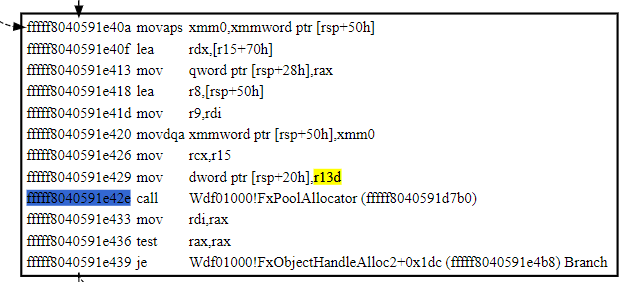
It came from r13d.
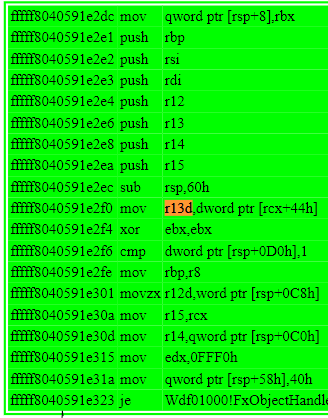
R13d came from [rcx+44]. We know RCX is _FX_DRIVER_GLOBALS . So basically voila.
8: kd> dt Wdf01000!_FX_DRIVER_GLOBALS
   +0x000 Linkage          : _LIST_ENTRY
   +0x010 Refcnt           : Int4B
   +0x018 DestroyEvent     : MxEvent
   +0x038 WdfHandleMask    : Uint8B
   +0x040 WdfVerifierAllocateFailCount : Int4B
   +0x044 Tag              : Uint4B
   +0x048 DriverObject     : MxDriverObject
   ...
Find the address of _FX_DRIVER_GLOBALS in our context (It’s in R15 of FxPoolAllocateWithTag2 ). We can validate this.
8: kd> dt Wdf01000!_FX_DRIVER_GLOBALS ffffac0e4c604db0
   +0x000 Linkage          : _LIST_ENTRY [ 0xffffac0e`4c68edb0 - 0xffffac0e`4c52a920 ]
   +0x010 Refcnt           : 0n1
   +0x018 DestroyEvent     : MxEvent
   +0x038 WdfHandleMask    : 0xffffffff`fffffff8
   +0x040 WdfVerifierAllocateFailCount : 0n-1
   +0x044 Tag              : 0x61646d61
   +0x048 DriverObject     : MxDriverObject
   +0x050 Driver           : 0xffffac0e`46565830 FxDriver
Cool.
Generalize debugging of WDF
Based on this information, we could roughly identify that all WDF objects created and associated with this set of _FX_DRIVER_GLOBALS will have the same pool tag.
See WDF, and you will realize that all WDF object starts in FxObject, and oh boy, that base class has a m_Type field. So, you can just dump out the memory, read the type and determine what to cast that object as.
Issue
Let’s apply what we know so far on the dump file.
- Pool tag
amdarefers to WDF objects belonging to ACP driver. - All WDF objects have the base class of
FxObject, and it contains am_Typefield.
We can find some instance of object, check its m_Type and understand more on where it came from.
0: kd> !poolfind amda -nonpaged

Scanning large pool allocation table for tag 0x61646d61 (amda) (ffffda0fe5b10000 : ffffda0fe5f10000)

ffffda0ff9791000 : tag amda, size    0x18f0, Nonpaged pool
ffffda0ff7ce01d0 : tag amda, size     0x3f0, Nonpaged pool
ffffda001accb5f0 : tag amda, size     0x140, Nonpaged pool
ffffda001accb740 : tag amda, size     0x140, Nonpaged pool
ffffda001accb890 : tag amda, size     0x140, Nonpaged pool
ffffda001accb9e0 : tag amda, size     0x140, Nonpaged pool
ffffda001accbb30 : tag amda, size     0x140, Nonpaged pool
ffffda001accbc80 : tag amda, size     0x140, Nonpaged pool
ffffda001accbdd0 : tag amda, size     0x140, Nonpaged pool
ffffda0ff9793000 : tag amda, size    0x18f0, Nonpaged pool
ffffda001acda620 : tag amda, size     0x140, Nonpaged pool
ffffda001acda770 : tag amda, size     0x140, Nonpaged pool
ffffda001acda8c0 : tag amda, size     0x140, Nonpaged pool
ffffda001acdaa10 : tag amda, size     0x140, Nonpaged pool
ffffda001acdab60 : tag amda, size     0x140, Nonpaged pool
ffffda001acdacb0 : tag amda, size     0x140, Nonpaged pool
ffffda001acdae00 : tag amda, size     0x140, Nonpaged pool
ffffda0ff7cde3f0 : tag amda, size     0x3f0, Nonpaged pool
ffffda0ff7cde800 : tag amda, size     0x300, Nonpaged pool
ffffda0ff7ce3000 : tag amda, size    0x3420, Nonpaged pool
ffffda0ff7ce6440 : tag amda, size     0x730, Nonpaged pool
ffffda0ff7ce6b90 : tag amda, size     0x3d0, Nonpaged pool

Searching nonpaged pool (ffffda0000000000 : ffffea0000000000) for tag 0x61646d61 (amda)

ffffda000a9b6d30 : tag amda, size     0x140, Nonpaged pool
ffffda000a9e0010 : tag amda, size     0x140, Nonpaged pool
ffffda000a9e0400 : tag amda, size     0x140, Nonpaged pool
ffffda000a9e07f0 : tag amda, size     0x140, Nonpaged pool
ffffda000a9e0be0 : tag amda, size     0x140, Nonpaged pool
ffffda000f102140 : tag amda, size     0x140, Nonpaged pool
ffffda000f102290 : tag amda, size     0x140, Nonpaged pool
ffffda000f1023e0 : tag amda, size     0x140, Nonpaged pool
... All 0x140 nonpaged
ffffda000f198e80 : tag amda, size     0x140, Nonpaged pool

...terminating - searched pool to ffffda000fb7df50
We should have a good idea now, whatever is running away is probably nonpaged, 0x140 in size.
Just take whatever one and find out what it is based on knowledge of WDF.
Take ffffda000f16ed30 as example, remember, all pool entry contains a HEADER of size 0x10. So we need to offset that.
8: kd> dt -v nt!_POOL_HEADER
struct _POOL_HEADER, 9 elements, 0x10 bytes
   +0x000 PreviousSize     : Bitfield Pos 0, 8 Bits
   +0x000 PoolIndex        : Bitfield Pos 8, 8 Bits
   +0x002 BlockSize        : Bitfield Pos 0, 8 Bits
   +0x002 PoolType         : Bitfield Pos 8, 8 Bits
   +0x000 Ulong1           : Uint4B
   +0x004 PoolTag          : Uint4B
   +0x008 ProcessBilled    : Ptr64 to struct _EPROCESS, 260 elements, 0x840 bytes
   +0x008 AllocatorBackTraceIndex : Uint2B
+0x00a PoolTagHash : Uint2B0: kd> dt Wdf01000!FxObject ffffda000f16ed30+10
+0x000 __VFN_table : 0xfffff800`5980dc30
+0x008 m_Type : 0x1025
+0x00a m_ObjectSize : 0xd0
+0x00c m_Refcnt : 0n2
+0x010 m_Globals : 0xffffda0f`f0157710 _FX_DRIVER_GLOBALS
+0x018 m_ObjectFlags : 0x819
+0x018 m_ObjectFlagsByName : FxObject::<unnamed-tag>::<unnamed-type-m_ObjectFlagsByName>
+0x01a m_ObjectState : 1
+0x020 m_ChildListHead : _LIST_ENTRY [ 0xffffda00`0f16ed60 - 0xffffda00`0f16ed60 ]
+0x030 m_SpinLock : MxLock
+0x040 m_ParentObject : 0xffffda0f`f7ce3000 FxObject
+0x048 m_ChildEntry : _LIST_ENTRY [ 0xffffda00`0f171cc8 - 0xffffda00`0f170288 ]
+0x058 m_DisposeSingleEntry : _SINGLE_LIST_ENTRY
+0x060 m_DeviceBase : 0xffffda0f`f7ce3000 FxDeviceBase
+0x060 m_Device : 0xffffda0f`f7ce3000 FxDeviceWe see type is 0x1025, so go to ReactOS reference and find the definition.
FX_TYPE_WORKITEM = FX_TYPES_BASE+0x25,It is a work item. We can cast it to get more details now.
0: kd> dt Wdf01000!FxWorkItem ffffda000f16ed30+10
   +0x000 __VFN_table : 0xfffff800`5980dc30
   +0x008 m_Type           : 0x1025
   +0x00a m_ObjectSize     : 0xd0
   +0x00c m_Refcnt         : 0n2
   +0x010 m_Globals        : 0xffffda0f`f0157710 _FX_DRIVER_GLOBALS
   +0x018 m_ObjectFlags    : 0x819
   +0x018 m_ObjectFlagsByName : FxObject::<unnamed-tag>::<unnamed-type-m_ObjectFlagsByName>
   +0x01a m_ObjectState    : 1
   +0x020 m_ChildListHead  : _LIST_ENTRY [ 0xffffda00`0f16ed60 - 0xffffda00`0f16ed60 ]
   +0x030 m_SpinLock       : MxLock
   +0x040 m_ParentObject   : 0xffffda0f`f7ce3000 FxObject
   +0x048 m_ChildEntry     : _LIST_ENTRY [ 0xffffda00`0f171cc8 - 0xffffda00`0f170288 ]
   +0x058 m_DisposeSingleEntry : _SINGLE_LIST_ENTRY
   +0x060 m_DeviceBase     : 0xffffda0f`f7ce3000 FxDeviceBase
   +0x060 m_Device         : 0xffffda0f`f7ce3000 FxDevice
   +0x068 m_NPLock         : MxLock
   +0x078 m_WorkItem       : MxWorkItem
   +0x080 m_RunningDown    : 0 ''
   +0x081 m_Enqueued       : 0 ''
   +0x084 m_WorkItemRunningCount : 0
   +0x088 m_Object         : 0xffffda0f`f7ce3000 FxObject
   +0x090 m_CallbackLock   : (null)
   +0x098 m_CallbackLockObject : (null)
   +0x0a0 m_Callback       : 0xfffff800`9f760a28     void  amdacpbus2!AcpDspResponseWorkItem+0
   +0x0a8 m_WorkItemCompleted : FxCREvent
   +0x0c8 m_WorkItemThread : (null)
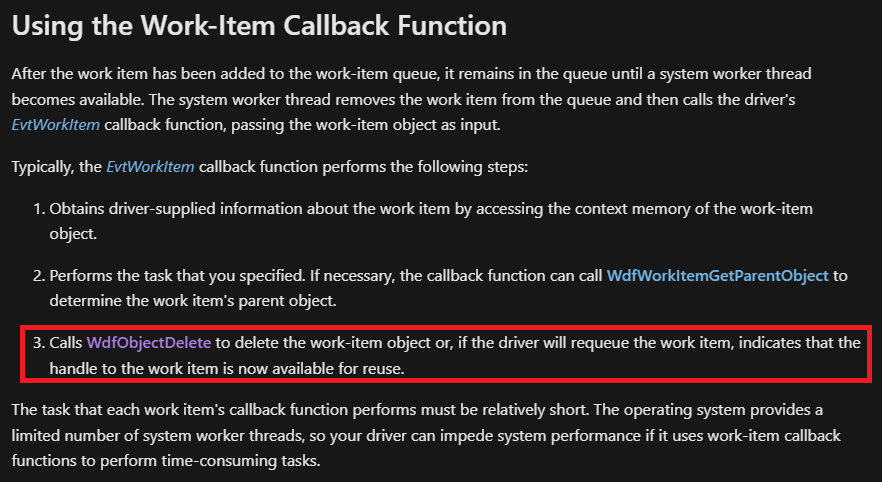
See https://learn.microsoft.com/en-us/windows-hardware/drivers/wdf/using-framework-work-items for more info on work item.
We must be queueing work item somewhere in our code, with amdacpbus2!AcpDspResponseWorkItem as callback. Search code on what we’re doing.
NTSTATUS
AcpCreateDspResponseWorkItems(
    _In_ AcpDeviceContext_t* _pDevCtx
)
{
    NTSTATUS Status = STATUS_UNSUCCESSFUL;
    ULONG Dspindex = 0;
    AcpWorkItemContext_t* workitemContext = NULL;

    if (_pDevCtx &&
        _pDevCtx->dsp_count > 0)
    {
        _pDevCtx->pDspResponseWorkItemHandles = (WDFWORKITEM*)AcpAlloc((sizeof(WDFWORKITEM) * _pDevCtx->dsp_count),
            ACP_TAG_DSP_RESPONSE_WORKITEM,
                NonPagedPool);
        if (_pDevCtx->pDspResponseWorkItemHandles)
        {
            for (Dspindex = 0; Dspindex < _pDevCtx->dsp_count; Dspindex++)
            {
                //work-item to process command response
                Status = AcpWorkItemCreate(_pDevCtx->AcpWdfDevice,
                    AcpDspResponseWorkItem,
                    &_pDevCtx->pDspResponseWorkItemHandles[Dspindex]);
                if (NT_SUCCESS(Status)) {
                    workitemContext = AcpGetWorkItemContext(_pDevCtx->pDspResponseWorkItemHandles[Dspindex]);
                    workitemContext->pDevCtx = _pDevCtx;
                    workitemContext->dsp_id = Dspindex;
                }
                else
                {
                    DBG_MSG(DBG_ERR, "AcpWorkItemCreate failed, DspId %d!!!", Dspindex);
                    goto Exit;
                }
            }
        }
        else
        {
            DBG_MSG(DBG_ERR, "AcpAlloc failed");
        }
    }

Exit:
    return Status;
}
Take a look on what we’re doing in the work item callback.
VOID
AcpDspResponseWorkItem(
    IN WDFWORKITEM _WorkItem
)
{
    AcpWorkItemContext_t* item;

    item = AcpGetWorkItemContext(_WorkItem);
    if (item)
    {
        EvGetResponse(item->pDevCtx,
            item->dsp_id);
    }
    else
    {
        DBG_MSG(DBG_WARN, "Invalid Workiten Context :0x%p", item);
    }
    return;
}